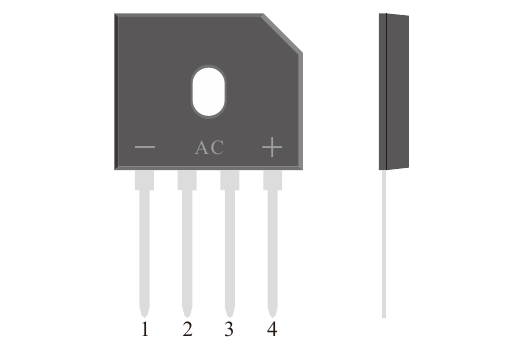
GBU · Datasheet illustration
Standard bridge rectifiers
GBU3516
1600 V, 35 A single-phase bridge rectifier in a GBU package. Review the electrical ratings and operating conditions below, with complete details in the datasheet.
Repetitive peak reverse voltage
1600 V
Rating
Conditions
Repetitive peak reverse voltage, VRRM.
Average rectified output current
35 A
Rating
Conditions
With heatsink at 100 °C, mounted on a 250 × 250 × 2 mm aluminum plate (note 2). Without heatsink: 4.2 A at 100 °C.
Forward voltage per diode
1.15 V
Maximum
Conditions
IF = 17.5 A; TA = 25 °C; per diode. Pulse test: 300 µs, 1% duty cycle.
Product status: MP
PRODUCT OVERVIEW
A closer look at GBU3516.
1600 V, 35 A single-phase bridge rectifier in a GBU package. Review the electrical ratings and operating conditions below, with complete details in the datasheet.
- Standard rectifier chip technology
- Low forward voltage drop
- Low leakage current
- High surge current capability
Technical specifications
- Repetitive peak reverse voltage
1600 VRating
Repetitive peak reverse voltage, VRRM.
Datasheet p. 1- Average rectified output current
35 ARating
With heatsink at 100 °C, mounted on a 250 × 250 × 2 mm aluminum plate (note 2). Without heatsink: 4.2 A at 100 °C.
Datasheet p. 1- Forward voltage per diode
1.15 VMaximum
IF = 17.5 A; TA = 25 °C; per diode. Pulse test: 300 µs, 1% duty cycle.
Datasheet p. 1- Non-repetitive surge current
350 ARating
8.3 ms single half-sine wave superimposed on rated load; per diode.
Datasheet p. 1- Reverse leakage current
5 µAMaximum
TA = 25 °C; VR = 1600 V (VRRM).
Datasheet p. 1- Junction temperature range
-55 to 150 °CRange
Operating junction temperature.
Datasheet p. 1
Values apply under their stated conditions. The datasheet includes the complete ratings, curves and package information.
Documents & downloads
GBU3516 datasheet
PDF · English
Typical applications
- Switch-mode power supplies
- Fast chargers
- LED drivers and monitor lighting
Application selection guides
Explore the circuit requirements for this component family and evaluate the device against your design conditions.